 Niwa
NiwaCrop rotation plan for a vegetable garden
Rotation is not about crops, it is about families. Radishes are brassicas, tomatoes and potatoes are the same family, and alliums need longer off than anything else in the garden.
Crop rotation is the highest-value thing you can do for a vegetable garden that costs nothing and takes no work, provided you get one thing right: you rotate families, not crops.
A gardener who follows tomatoes with peppers has technically changed crop and changed nothing at all. Both are nightshades. The soil-borne fungi, the nematodes and the nutrient draw are identical.
What rotation actually fixes
Three separate problems, on different timescales:
- Soil-borne disease. Clubroot in brassicas, white rot in alliums, blight and verticillium wilt in nightshades. These persist in soil for years and build with each host crop. This is the main reason to rotate.
- Pest life cycles. Carrot root fly, cabbage root fly and Colorado potato beetle overwinter in soil expecting the same crop to return. Move the crop and they emerge with nothing to eat.
- Nutrient balance. Brassicas are nitrogen-hungry. Legumes fix nitrogen. Root crops want phosphorus and potassium but little nitrogen. Sequenced properly, each crop leaves soil in the state the next one wants.
The eight families
Learn these and rotation becomes trivial. The surprises are marked.
| Family | Crops |
|---|---|
| Nightshades (Solanaceae) | Tomato, potato, pepper, chilli, aubergine, tomatillo |
| Brassicas (Brassicaceae) | Cabbage, broccoli, cauliflower, kale, Brussels sprout, kohlrabi, radish, turnip, swede, rocket, pak choi, mustard |
| Legumes (Fabaceae) | Peas, broad beans, French beans, runner beans, lentils, clover |
| Alliums (Amaryllidaceae) | Onion, garlic, leek, shallot, chive, spring onion |
| Cucurbits (Cucurbitaceae) | Cucumber, courgette, marrow, pumpkin, winter squash, melon |
| Umbellifers (Apiaceae) | Carrot, parsnip, celery, celeriac, fennel, parsley, dill, coriander |
| Goosefoots (Amaranthaceae) | Beetroot, chard, spinach, quinoa |
| Asters (Asteraceae) | Lettuce, chicory, endive, artichoke, sunflower |
The two that break most rotation plans: radishes are brassicas: used constantly as a quick filler crop, and they carry clubroot risk. And tomatoes and potatoes are the same family, which surprises people every year.
How long each family needs off
| Family | Years off | Driven by |
|---|---|---|
| Alliums | 5+ | White rot: sclerotia survive a decade or more |
| Brassicas | 4 | Clubroot: spores survive up to 20 years once established |
| Nightshades | 3-4 | Blight, verticillium and fusarium wilt, nematodes |
| Umbellifers | 3 | Carrot root fly, sclerotinia |
| Cucurbits | 3 | Fusarium wilt, bacterial wilt |
| Goosefoots | 2-3 | Leaf miner, downy mildew |
| Asters | 2 | Sclerotinia, aster yellows |
| Legumes | 2 | Least demanding: and they improve soil |
The sequence that works
Rotation is not just avoidance. Some sequences actively help:
- Brassicas after legumes. The single best pairing in the garden. Legumes leave nitrogen in root nodules; brassicas are the hungriest nitrogen feeders you grow. Do this one thing and you will notice.
- Roots after brassicas. Brassicas strip the excess nitrogen that would otherwise make carrots fork and split.
- Legumes after nightshades. Tomatoes leave soil depleted; legumes restore it.
- Alliums after almost anything. Light feeders, tolerant of what came before. Just do not let them return to their own square for five years.
And the sequences to avoid: nightshades after nightshades in any combination, brassicas after brassicas including a radish filler crop, and alliums after alliums.
A four-year plan
Four beds, four groups, rotating one bed forward each year.
| Year | Bed 1 | Bed 2 | Bed 3 | Bed 4 |
|---|---|---|---|---|
| Year 1 | Legumes | Brassicas | Roots | Nightshades |
| Year 2 | Brassicas | Roots | Nightshades | Legumes |
| Year 3 | Roots | Nightshades | Legumes | Brassicas |
| Year 4 | Nightshades | Legumes | Brassicas | Roots |
"Roots" here bundles umbellifers, alliums and goosefoots. If you grow a lot of onions or garlic, split them out and run a five-bed rotation instead, because alliums need the extra year.
Cucurbits are usually slotted alongside nightshades, since they occupy similar space and both are hungry.
Rotating a single bed
Most people have one or two beds, not four, and conclude rotation is impossible. It is not. You just rotate at square resolution instead of bed resolution.
In a 4×8 bed with thirty-two squares:
- Divide the bed into four notional quarters of eight squares each.
- Assign each quarter a family group this season.
- Next season, shift each group one quarter along.
- Track it per square, not per quarter, because a mid-season succession crop will break the quarter boundary the moment you plant a radish in a legume square.
This is genuinely harder than four-bed rotation for one reason: nobody can remember, in March, what was in square 14 two seasons ago.
Why alliums are the special case
Allium white rot (Sclerotium cepivorum) produces sclerotia, hard survival structures that sit dormant in soil and germinate only when they detect allium root exudates. They remain viable for fifteen years or more.
Practically: if you have had white rot, that ground is finished for alliums for a very long time, and the fungus travels on boots and tools. If you have not, keeping a five-year minimum gap is cheap insurance against the one soil problem in a vegetable garden you cannot fix.
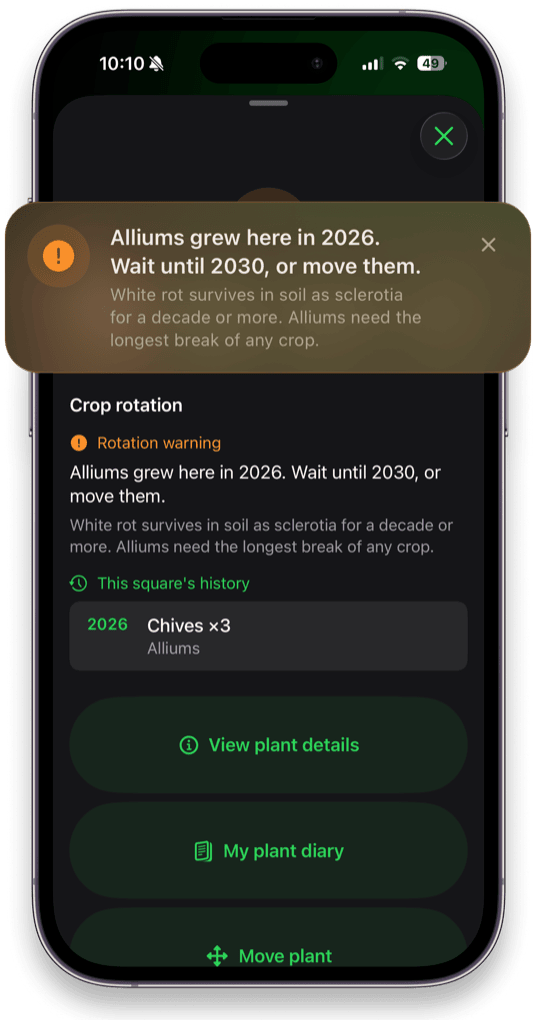
The memory problem
Rotation is not intellectually difficult. The families take ten minutes to learn. The reason almost nobody does it properly is that it requires perfect recall of what grew in every square, for four years, across succession crops, and a notebook in a shed does not survive contact with a real season.
Pair it with what not to plant together for the adjacency side of the same problem: rotation handles time, companion checking handles space.