 Niwa
NiwaWhat not to plant together
Most bad-neighbour charts are folklore copied between websites since the 1970s. Roughly a dozen pairings genuinely cost you yield. These are those, with the mechanism for each.
Search "what not to plant together" and you will get charts claiming that beans hate beetroot and that cucumbers cannot go near sage. Trace those claims back and most end at a single 1970s book with no data behind it.
Meanwhile, several genuinely damaging pairings are routinely planted by people who read those charts. This guide sorts the two.
The pairings that genuinely matter
| Do not plant | Next to | Why |
|---|---|---|
| Fennel | Almost everything | Allelopathic: root exudates inhibit germination and growth in beans, tomatoes, brassicas and more |
| Onion, garlic, leek, chives | Beans, peas | Sulphur compounds suppress the Rhizobium bacteria legumes need to fix nitrogen |
| Tomato | Potato | Same family, shared late blight; an outbreak in one is an outbreak in both |
| Tomato | Corn | Corn earworm and tomato fruitworm are the same insect |
| Tomato, pepper, aubergine | Brassicas | Competing heavy feeders wanting different soil pH |
| Potato | Squash, cucumber | Squash increases potato blight susceptibility; harvesting potatoes wrecks squash roots |
| Carrot | Dill (once flowering) | Same family: they cross-pollinate and compete once dill bolts |
| Mint | Anything, ever | Not chemistry, just conquest. Runners take a whole bed in two seasons |
| Sunflower | Potato, pole beans | Allelopathic to some crops, plus heavy shade and heavy feeding |
| Black walnut (nearby tree) | Tomato, pepper, aubergine, potato | Juglone in roots and leaf litter kills nightshades outright, up to 50ft from the trunk |
| Brassicas | Strawberries | Brassicas outcompete strawberries badly for nitrogen |
| Asparagus | Onion, garlic | Alliums stunt asparagus crowns, and asparagus beds are permanent so the damage compounds |
The four real mechanisms
1. Allelopathy
Some plants release chemicals that inhibit others. This is documented, measurable and the strongest reason to separate crops. Fennel, sunflower and black walnut are the ones that matter in a vegetable garden. Black walnut is the extreme case: juglone leaches from roots and fallen leaves and will kill a tomato outright, so a bed within about fifty feet of one needs to be a raised bed with a barrier.
2. Shared pests and disease
Anything in the same family shares the same enemies. Nightshades (tomato, potato, pepper, aubergine) share blight and Colorado potato beetle. Brassicas share cabbage white and clubroot. Cucurbits share squash vine borer and powdery mildew. Planting family members adjacent turns a local problem into a bed-wide one.
3. Nutrient and root competition
Two heavy feeders in adjacent squares peaking in the same six weeks will both underperform. Brassicas and nightshades are the classic collision. So are two deep-rooted crops competing for the same soil volume. The answer is to pair a deep rooter with a shallow one, not two of either.
4. Physical interference
The least discussed and most common. Squash smothers what it reaches. Sunflowers cast shade across half a bed by August. Harvesting potatoes means digging over a square foot of soil, which destroys anything rooted next to it. Mint simply takes the bed.
Myths you can ignore
These appear on nearly every chart and have no support:
- Beans and beetroot: grown together commercially without issue.
- Cucumbers and aromatic herbs: sage, rosemary and cucumbers coexist fine.
- Lettuce and celery: no known mechanism at all.
- Peppers and beans: appears on charts constantly; nothing behind it.
- Onions and everything: alliums are a problem specifically for legumes and asparagus. They are neutral-to-helpful next to carrots, brassicas and tomatoes.
- Tomatoes and cucumbers: different families, different pests, no conflict. They want the same conditions, which is why they are often grown side by side in greenhouses.
A useful test: if a claimed conflict has no stated mechanism (no chemical, no shared pest, no competition, no physical interference), it is almost certainly copied folklore. Real conflicts have reasons.
The conflict that lasts for years
Adjacency is only half the problem. The other half is succession: what you plant in a square after something else, sometimes years later.
Alliums are the extreme case. White rot survives in soil as sclerotia for a decade or more, so an onion square is not safe for another allium for years, and radishes count as brassicas, tomatoes and potatoes are both nightshades, and the soil does not care what you call them.
That is a memory problem, not a knowledge problem, and it is covered in the crop rotation guide.
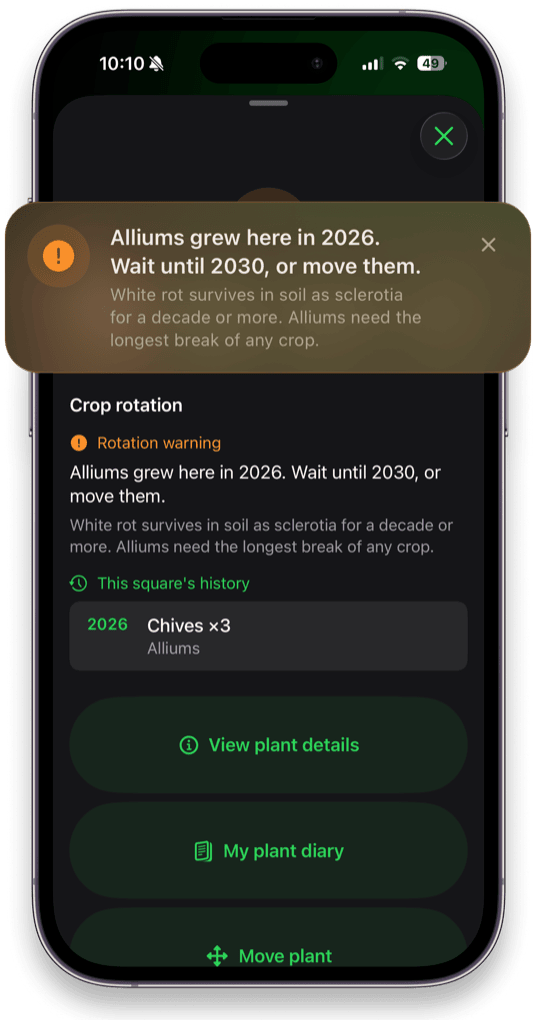
Catching conflicts before you dig
Every conflict above is trivial to avoid and easy to miss, because checking a bed by hand means examining every adjacent pair, and a 32-square bed has over fifty adjacencies.