 Niwa
NiwaWhat to plant with tomatoes
Basil next to tomatoes is the most repeated advice in gardening. Some of it holds up, some of it does not. Here is which companions earn their square, and why.
Companion planting has a credibility problem. The charts that circulate online mix genuine, tested plant relationships with folklore that has been copied from chart to chart since the 1970s without anyone checking it.
For tomatoes specifically, four mechanisms are real: pest confusion, beneficial insect attraction, space complementarity and nematode suppression. Everything below is sorted by which of those it actually does.
The companions that earn their square
| Plant | What it does | Where to put it |
|---|---|---|
| Basil | Disrupts thrips and whitefly host-finding; same water and heat needs | Squares adjacent, 4 per square |
| French marigold | Root exudates suppress root-knot nematodes | Bed edges, 4 per square |
| Borage | Strong pollinator magnet; may deter tomato hornworm | One corner square, it gets large |
| Chives & garlic | Sulphur compounds deter aphids and some fungal issues | Adjacent squares, 16 per square |
| Parsley | Umbel flowers feed parasitic wasps that predate hornworm | Let some bolt: the flowers are the point |
| Carrots | Uses the deep soil tomatoes leave alone | Below, 16 per square |
| Lettuce | Occupies low space; benefits from tomato shade in heat | South side of the tomato row |
| Nasturtium | Trap crop: aphids go to it instead | Bed edge, expect it to sprawl |
| Asparagus | Mutual: tomatoes deter asparagus beetle, asparagus deters some nematodes | Only in a permanent bed |
What each one is actually doing
Pest confusion (basil, chives, garlic)
Insects locate host plants largely by smell. A strongly aromatic plant in the same airspace raises the noise floor, and pests that would have found your tomato in twenty seconds take four minutes, or give up. This is why the effect scales with quantity of aromatic planting, not with proximity of a single plant. One basil in the corner of a bed does approximately nothing. Twelve basil plants distributed among six tomatoes is a different situation.
Beneficial insects (borage, parsley, dill, alyssum)
The single most valuable thing you can do for a tomato bed is feed the predators of tomato pests. Parasitic wasps that lay eggs in hornworm caterpillars need nectar from small, shallow flowers: the umbels of parsley, dill and coriander, and the tiny flowers of sweet alyssum. Letting a couple of herbs bolt and flower is not neglect, it is the strategy.
Space complementarity (carrots, lettuce, spring onions)
A staked indeterminate tomato is essentially a vertical line with nothing happening in the bottom eight inches. Anything short and shallow-rooted can use that space at no cost to the tomato. This is the least glamorous mechanism and by far the most reliable one.
Nematode suppression (French marigold)
Tagetes patula releases alpha-terthienyl from its roots, which is genuinely toxic to root-knot nematodes. But this is a soil effect built over a season, not an airborne one. If you have a nematode problem, the effective move is a full marigold cover crop the season before tomatoes, not a border this year.
The four to keep away
- Brassicas (cabbage, broccoli, cauliflower, kale): both are heavy feeders peaking in the same window, and brassicas prefer a higher soil pH than tomatoes. Someone loses.
- Potatoes: same family, same blight. An outbreak in one is an outbreak in both, and it also wrecks your rotation for years.
- Corn: corn earworm and tomato fruitworm are the same insect, Helicoverpa zea. Planting both is a breeding programme.
- Fennel: allelopathic to nearly everything. Grow it in a container elsewhere.
Dill is the interesting edge case: excellent next to young tomatoes because it pulls in beneficials, and worth removing once it starts to flower and set seed, when it begins competing directly. The full list is in what not to plant together.
A worked 4x8 tomato bed
Thirty-two squares, four indeterminate tomatoes on a trellis along the north edge:
| Position | Planting |
|---|---|
| Row 1 (north, trellised) | 4 tomatoes × 1 per square, 4 squares of basil between and behind |
| Row 2 | Basil × 4, parsley × 4, chives × 16, basil × 4: alternating aromatics |
| Row 3 | Carrots × 16 and beetroot × 9, using the deep soil |
| Row 4 (south) | Lettuce × 4 per square, French marigolds on the two corner squares |
That bed gives you four aromatic squares per tomato, a bolted-parsley nectar source for wasps, marigolds building nematode suppression for next season, and two crops using space the tomatoes never touch.
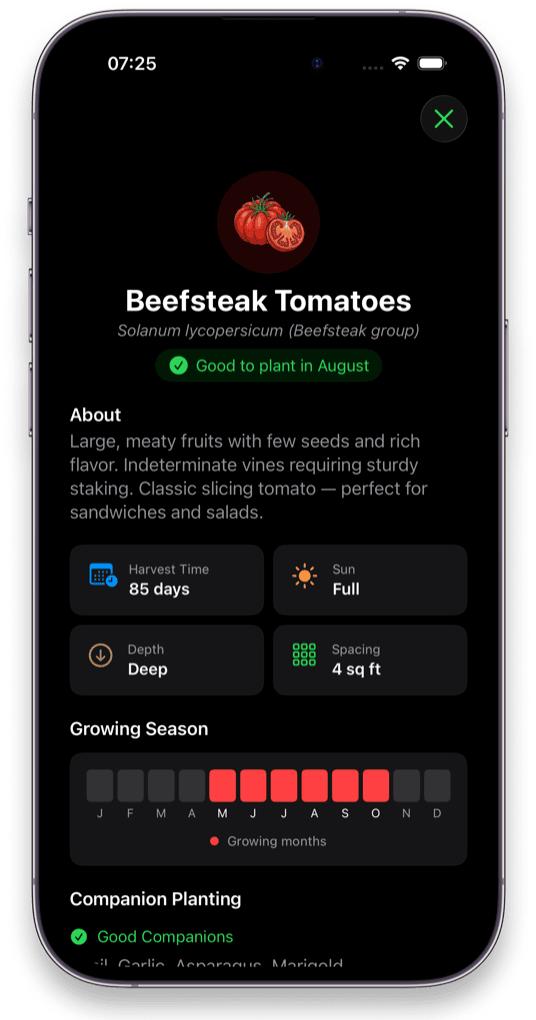
Doing this on a real garden grid
The reason companion planting stays theoretical for most people is that a chart tells you about pairs, while a bed is a two-dimensional arrangement of a dozen plants. Checking every adjacency by hand is tedious enough that nobody does it.