 Niwa
NiwaWhen to start seeds indoors
Every indoor sowing date is one subtraction from your last frost date. Get the number of weeks wrong and you get leggy, root-bound seedlings that never catch up.
Starting seeds indoors buys you a head start on the season: six to ten weeks of growth that happens before your soil is workable. In a short season it is the difference between harvesting peppers and watching them flower in September.
It also goes wrong more often than any other beginner technique, almost always for the same reason: starting too early.
The one calculation
Indoor sow date = your last frost date, minus the crop's head-start weeks
That is the entire method. If your last frost is 15 April and tomatoes need seven weeks, you sow around 25 February. The only inputs are your own frost date (see when to plant vegetables in your zone) and the table below.
Weeks-before-frost chart
| Crop | Weeks before last frost | Transplant out |
|---|---|---|
| Onion, leek (from seed) | 10-12 | 4-6 weeks before frost |
| Celery, celeriac | 10-12 | 1-2 weeks after |
| Pepper, chilli | 8-10 | 2 weeks after |
| Aubergine | 8-10 | 2 weeks after |
| Tomato | 6-8 | 1-2 weeks after |
| Broccoli, cauliflower | 5-6 | 2-4 weeks before |
| Cabbage, Brussels sprout | 5-6 | 2-4 weeks before |
| Kale, kohlrabi | 4-6 | 2-4 weeks before |
| Lettuce | 4-6 | 2-4 weeks before |
| Chard, spinach | 4-6 | 2-3 weeks before |
| Basil | 4-6 | 2 weeks after |
| Cucumber | 3-4 | 1-2 weeks after |
| Courgette, squash | 3-4 | 1-2 weeks after |
| Melon | 3-4 | 2-3 weeks after |
| Marigold, most annual flowers | 6-8 | After frost |
Where a range is given, use the shorter figure unless you have proper grow lights. Under a windowsill, the extra two weeks produce a taller, weaker plant rather than a bigger one.
What not to start indoors
Some crops are worse for it:
- Carrots, parsnips: a disturbed taproot forks permanently. Direct sow, always.
- Radish, turnip: 25 to 50 days to harvest. There is nothing to gain.
- Beetroot: transplantable but rarely worth the effort.
- Peas: germinate in cold soil, so direct sowing is already early.
- Beans, corn: fast, and both resent root disturbance.
- Sweetcorn: needs a block for wind pollination; transplanting rarely helps.
Why too early is worse than too late
Sowing tomatoes twelve weeks out feels productive in February. What actually happens:
- Legginess. Indoor light is a fraction of outdoor light. A seedling held too long stretches for it, producing a thin weak stem it never recovers from.
- Root binding. Roots circle the cell and set in that shape. A root-bound transplant establishes slowly, if at all.
- Potting-on treadmill. You end up repotting three times, each transplant setting the plant back.
- Premature flowering. A stressed, pot-bound seedling flowers early in a cell, wasting energy on fruit it cannot support.
A tomato sown at six weeks and planted into warm soil will overtake one sown at twelve weeks and planted into the same soil. Every year, reliably.
Light is the thing people get wrong
A south-facing windowsill provides perhaps a tenth of what a seedling wants. Signs you are short: stems stretching, seedlings leaning hard toward the glass, long gaps between leaf pairs, pale colour.
What works: a cheap LED shop light kept five to fifteen centimetres above the leaf canopy and raised as plants grow, running fourteen to sixteen hours a day. The distance matters far more than the fixture's wattage.
Two other things that matter more than they look: bottom heat at 21-27°C for germination of peppers, aubergines and tomatoes (a heat mat halves germination time), and airflow. A small fan on low for a few hours daily thickens stems and prevents damping off, which is the fungal collapse that kills a whole tray overnight.
Hardening off
An indoor seedling moved straight outside can be scorched or wind-shredded in a day. Give it seven to ten days:
| Day | Outdoor exposure |
|---|---|
| 1-2 | 1-2 hours, full shade, sheltered |
| 3-4 | 3-4 hours, dappled shade, a little breeze |
| 5-6 | Most of the day, some direct morning sun |
| 7-8 | Full day outside, direct sun, brought in at night |
| 9-10 | Left out overnight if no frost is forecast |
Plan this inside your window, not after it. Hardening off begins about ten days before the transplant date, not on it.
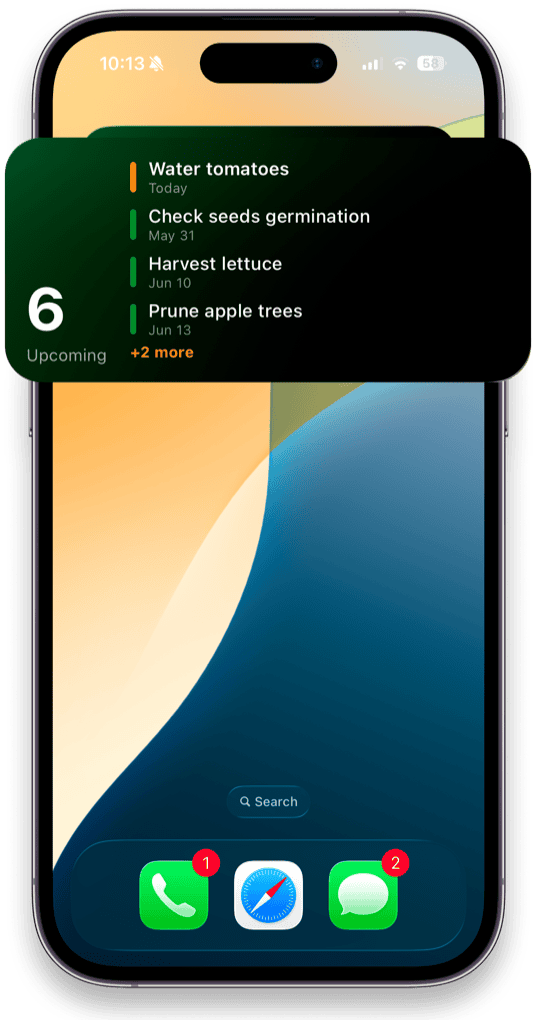
Getting your sow dates automatically
The chart above is a subtraction repeated fourteen times, redone every year, with dates that then have to be remembered across three months of winter. That is a reminder problem, not a gardening problem.