 Niwa
NiwaSmall backyard vegetable garden layouts
A small garden does not need a smaller plan. It needs a denser one: vertical, intensive and worked three times a season instead of once.
The constraint in a small garden is not really area. It is that most people plan a small garden the way they would plan a big one, just with fewer plants.
The three levers that actually change what a small space produces are vertical growing, succession sowing and crop selection by value. Applied together they roughly triple output from the same footprint.
Grow up, not out
A sprawling cucumber uses about nine square feet of ground. The same plant on a trellis uses one, and produces cleaner fruit with less mildew because of the airflow.
| Crop | Sprawling | Vertical |
|---|---|---|
| Cucumber | ~9 sq ft | 1 sq ft, 2 plants |
| Pole beans | n/a | 1 sq ft, 8 plants |
| Peas / mangetout | n/a | 1 sq ft, 8 plants |
| Small winter squash | ~16 sq ft | 1-2 sq ft with fruit slings |
| Indeterminate tomato | ~4 sq ft | 1 sq ft, staked |
| Melon (small varieties) | ~16 sq ft | 2 sq ft with slings |
Put every trellis on the north edge so the vertical growth shades a fence rather than your bed.
Work the space three times
A square that grows one crop a year is running at a third of capacity. Three-pass sequences that fit almost any season:
- Radish (30 days) → bush beans (60 days) → spinach (45 days)
- Spinach (45) → cherry tomato (70) → rocket (30)
- Lettuce (50) → courgette (60) → pak choi (45)
- Peas (60) → carrots (70) → garlic (overwintering)
This requires knowing your season length precisely. See when to plant vegetables in your zone. In a 160-day season, three 50-day crops fit. In a 100-day season, two.
Choose by value per square foot
In a small garden every square is competing, so judge crops on what they cost to buy versus what they yield.
| Grow these | Not these |
|---|---|
| Fresh herbs (basil, coriander, dill, parsley) | Maincrop potatoes |
| Salad leaves, rocket, mizuna | Onions |
| Cherry tomatoes | Cabbage |
| Chillies | Sweetcorn |
| Mangetout and sugar snaps | Pumpkins |
| Spring onions | Marrows |
| Radish and baby turnip | Maincrop carrots (grow baby ones instead) |
The rule of thumb: if it is cheap in a shop and stores well, buy it. If it is expensive, perishable, and tastes dramatically better fresh, grow it.
Three small-space layouts
The 4×4 kitchen garden (16 squares)
| Row | Planting |
|---|---|
| Row 1 (north, trellis) | Cherry tomato ×1, mangetout ×8, mangetout ×8, cucumber ×2 |
| Row 2 | Basil ×4, basil ×4, coriander ×4, parsley ×4 |
| Row 3 | Salad leaves ×4, salad leaves ×4, rocket ×9, bush beans ×9 |
| Row 4 (south) | Radish ×16, spring onion ×16, chives ×16, thyme ×4 |
Sixteen squares producing salad, herbs and tomatoes continuously from spring to autumn.
The narrow side return (2ft × 10ft)
Twenty squares in a strip. Trellis the entire back wall: pole beans, cucumbers, mangetout. The front row takes shade-tolerant crops: lettuce, spinach, chard, mint in a sunken pot, parsley. Side returns are usually part-shaded, which suits leafy crops far better than fruiting ones.
The doorstep bed (2ft × 4ft)
Eight squares, all culinary: two basil, one coriander, one parsley, one chives, one thyme, one spring onion, one salad. Put it by the kitchen door. Herbs get used when they are within ten steps of a chopping board and ignored when they are not.
Balconies and containers
If you have no ground at all, containers work with three caveats: depth, watering and feeding.
| Container depth | Suits |
|---|---|
| 15cm / 6in | Salad, rocket, radish, most herbs |
| 25cm / 10in | Spring onions, chard, bush beans, baby carrots |
| 30cm / 12in | Cherry tomatoes, chillies, kale, dwarf beans |
| 40cm+ / 16in | Full-size tomatoes, aubergine, potatoes in a sack |
Containers dry out several times faster than beds, so expect to water daily in summer, twice on hot days. And because you water so often, nutrients leach out fast, so feed fortnightly from midsummer. A larger container is always easier than a small one.
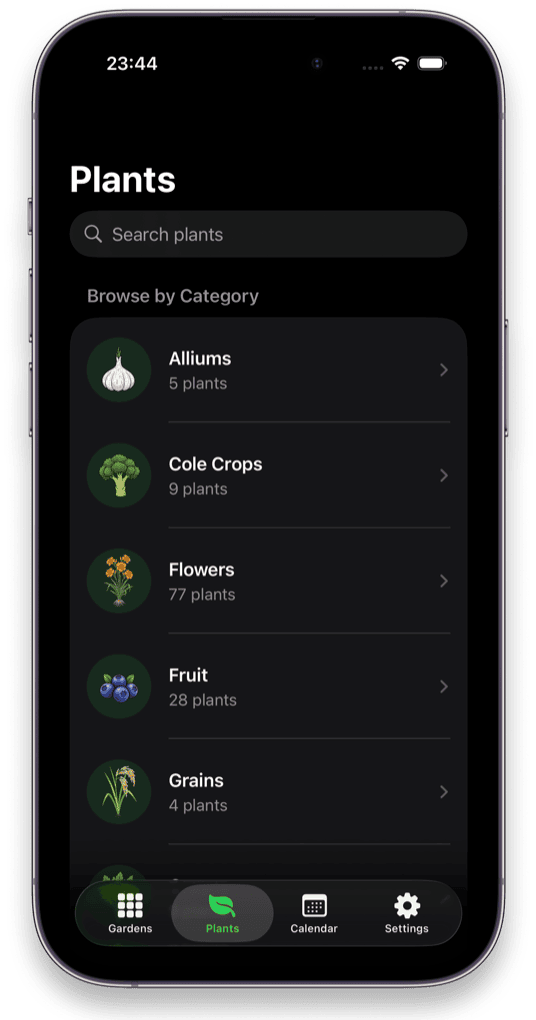
Planning density on a phone
Intensive planting is harder to plan than ordinary planting, because every square is doing more work and every mistake costs proportionally more. Three passes across sixteen squares is forty-eight decisions, each with a date attached.