 Niwa
NiwaKeeping a garden journal (and the app that does it)
The difference between a second-year gardener and a first-year gardener repeating themselves is a written record. Here is what is worth recording, and what is not.
A vegetable garden gives you one attempt a year. Ten years of gardening is ten data points, and only if you wrote them down.
This is the actual reason experienced gardeners get better results: not intuition, but accumulated records of what worked in their soil, in their climate, with their varieties. Every general growing guide, including the ones on this site, is an average. Your garden is not average.
The six things worth recording
- Sowing and transplant dates. Not "spring". The actual date. Next year you will want to know whether to go earlier or later, and that question is unanswerable without the number.
- What grew in each square. The foundation of crop rotation, and the record people most reliably fail to keep.
- Germination rate by variety. "Sowed 20, got 6" is the single most actionable note in a garden journal. It tells you the seed is old, the soil was too cold, or the supplier is poor, and all three change what you do next.
- First and last harvest dates. Packet days-to-harvest figures are optimistic averages. Your own numbers are accurate, and they are what makes succession planning possible.
- Pest and disease events, with dates. Aphids in the third week of May, two years running, is a pattern you can act on. "Had aphids at some point" is not.
- Photos. More on this below.
What is not worth recording
Journal templates tend to ask for far more than anyone sustains. Things people record enthusiastically in April and never read again:
- Daily weather. Available from any archive afterwards, and rarely the explanatory variable you thought it was.
- Every watering. Unless you are diagnosing a specific problem, this is noise.
- Detailed soil amendment logs. A yearly note is enough.
- Costs. Interesting once, then discouraging, then abandoned.
A journal you maintain for one season and abandon is worth less than a sparse one you keep for five. Record less, for longer.
Why photos beat notes
A written note requires you to already know what mattered. A photo captures things you did not know to look for.
Photographed on the day, then looked at a year later, a bed tells you: how large the plants actually were at that date, how much space you genuinely had left, what the leaf colour was before the problem appeared, and how dense the planting really was compared to how dense you remember it being.
Three photos per crop is enough: shortly after planting, mid-season, and at first harvest. The date is the important part, which is why the photo needs to be attached to the plant rather than lost in a camera roll of thousands.
The seed inventory problem
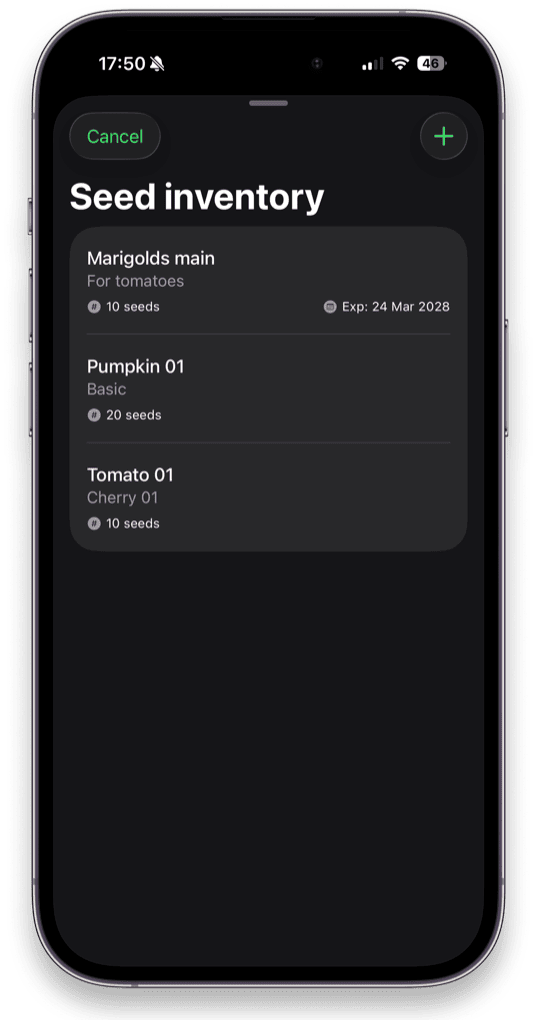
Every gardener eventually owns a shoebox of half-used seed packets in unknown condition, and every gardener orders seed they already have.
Two facts make this worth tracking. First, seed viability varies enormously by species:
| Seed | Realistic viability |
|---|---|
| Onion, leek, parsnip | 1 year |
| Sweetcorn, pepper, carrot | 2-3 years |
| Bean, pea, spinach | 3 years |
| Tomato, brassicas, beetroot | 4-5 years |
| Cucumber, courgette, squash, lettuce | 5-6 years |
Second, "expired" is not binary. Germination declines gradually. Old seed is still usable if you sow it thicker. But you have to know how old it is, which means writing it down when you buy it, not guessing in March.
Per-square history
The most valuable record is also the hardest to keep by hand: what grew in each individual square, each season.
It drives rotation warnings, explains why one corner of a bed underperforms, and tells you whether a disease is recurring in one spot or moving. Kept on paper it requires a numbered grid diagram redrawn every season, with mid-season succession crops added as they happen. Almost nobody sustains that past the first year.
Doing it without a notebook
Paper journals fail for mundane reasons: the notebook is in the house when you are in the garden, and in the shed when you want to plan. Your phone is in your pocket in both places.
The payoff is not this season. It is the March two years from now when you open the app and find out exactly what you did, when, and how it went. More on the privacy and offline side in choosing a garden planner that works offline.