 Niwa
NiwaA beginner's vegetable garden plan
First gardens fail for four predictable reasons, none of which are difficulty. Here is a first-season plan built to avoid all four.
Beginner vegetable gardens rarely fail because vegetables are hard. They fail for four reasons:
- Too big. The garden becomes a chore by July and gets abandoned in August.
- Wrong timing. Tender crops planted before the last frost, or cool crops planted into summer heat.
- Too crowded. Sixteen tomato plants in eight square feet, none of which produce.
- Not enough sun. A bed in four hours of light will never work, no matter what goes in it.
This plan is built to make all four difficult to do.
Start with 32 square feet
One raised bed, four feet by eight feet, twelve inches deep. That is the recommendation, and the number one reason people ignore it is that it looks small in March.
It is not small. Thirty-two squares planted properly produce more than most households eat, and it is the largest area a beginner can reliably keep weeded, watered and harvested through a full season without it becoming an obligation.
Depth, orientation and soil mix are covered in the 4×8 raised bed layout guide. Short version: twelve inches deep, long axis east-west, one third compost, one third topsoil, one third aeration material.
Check the sun honestly
Photograph the site at 9am, noon, 3pm and 6pm on a clear day. You need six hours of direct sun minimum, eight for tomatoes and peppers.
People overestimate their sun by about two hours, consistently. If your estimate is six, plan as though it is five and choose accordingly: leafy greens and roots do fine on five hours, fruiting crops do not.
Ten crops that forgive beginners
| Crop | Days to harvest | Why it is forgiving |
|---|---|---|
| Radish | 25-30 | Germinates in 3 days, tolerates poor soil, fast reward |
| Lettuce | 45-55 | Cut and come again, tolerates part shade |
| Bush beans | 50-60 | Direct sow, no support, heavy cropping |
| Courgette | 50-60 | Almost impossible to fail. Plant ONE. |
| Cherry tomato | 60-70 | Far more forgiving than beefsteak types |
| Spring onion | 60-70 | Dense, untroubled by pests |
| Chard | 50-60 | Harvest for months from one sowing |
| Basil | 50-60 | Expensive to buy, trivial to grow |
| Carrot | 65-75 | Needs loose soil, otherwise undemanding |
| Spinach | 40-50 | Fast, cold-tolerant, spring and autumn |
Four crops to skip in year one
- Cauliflower: unforgiving about temperature and water, and one bad week gives you a head the size of a coin.
- Celery: wants constant moisture and a long season. Difficult even for experienced growers.
- Melon: needs heat, space and a long season, and often yields one fruit.
- Sweetcorn: needs a block for pollination, so a single row gives you bare cobs. Poor value per square foot anyway.
Also: plant one courgette. Not three. One plant produces more than a household can eat.
The square-by-square plan
| Row | Planting |
|---|---|
| Row 1 (north) | Cherry tomato ×1, basil ×4, cherry tomato ×1, basil ×4, courgette (2 squares), marigold ×4, marigold ×4 |
| Row 2 | Bush beans ×9 ×3 squares, chard ×4 ×2, spring onion ×16 ×3 |
| Row 3 | Carrot ×16 ×3, radish ×16 ×2, carrot ×16, radish ×16, spinach ×9 |
| Row 4 (south) | Lettuce ×4 ×5 squares, spinach ×9 ×2, parsley ×4 |
Tall on the north, low on the south, aromatics scattered between the fruiting crops, and radish squares that empty in a month and become your first succession sowing.
Month by month
Expressed relative to your last frost date, which is the only reliable anchor (see when to plant vegetables in your zone).
| Timing | Do this |
|---|---|
| 8-10 weeks before last frost | Build the bed, fill it, order seed. Start tomato and basil indoors at 6-8 weeks. |
| 4-6 weeks before | Direct sow radish, spinach, lettuce, carrots, spring onions. They handle light frost. |
| Last frost week | Begin hardening off tomatoes and basil. Do not plant them out yet. |
| 1-2 weeks after | Plant out tomatoes, basil, courgette. Direct sow bush beans and chard. |
| 4 weeks after | First radish harvest. Resow those squares immediately with lettuce or beans. |
| Midsummer | Harvest continually. Cut-and-come-again on lettuce and chard. Water deeply twice a week, not shallowly daily. |
| 10-12 weeks before first frost | Sow autumn spinach, lettuce, radish into squares as summer crops finish. |
| After first frost | Clear the bed, top up with compost, and record what grew where. |
Three habits worth more than technique
- Water deeply, not often. A long soak twice a week drives roots down. Daily sprinkling keeps roots at the surface where they cook in the first hot week.
- Succession sow. Never plant a whole square of lettuce at once. A quarter-square every fortnight gives you salad for months instead of sixteen lettuces in one week.
- Write down what happened. What you planted, when, and how it did. This is the single thing that separates a second-year gardener from a first-year gardener repeating themselves.
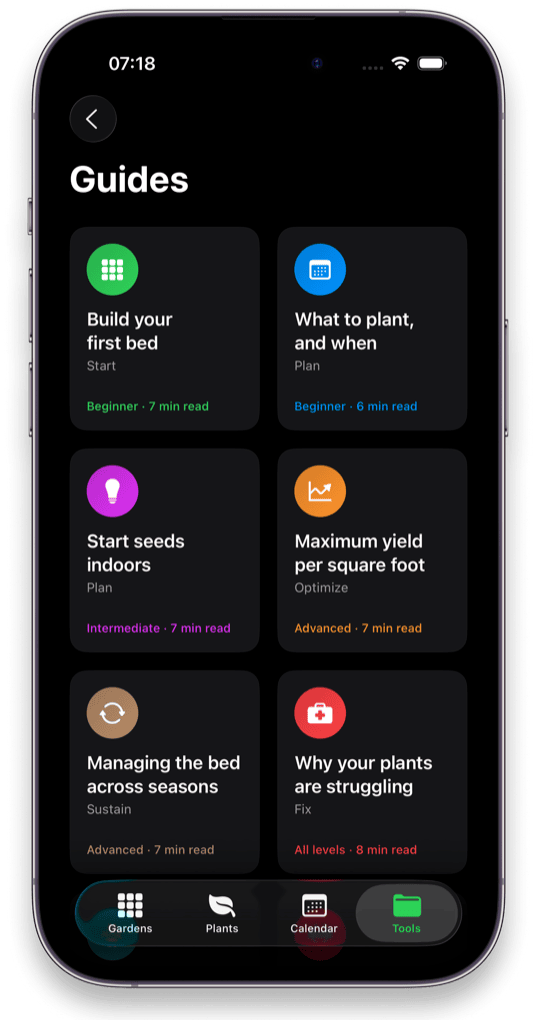
Keeping it on track
Almost everything above is bookkeeping: dates, spacing, what went where. That is precisely what tends to slip in a first season, and precisely what a phone is good at.